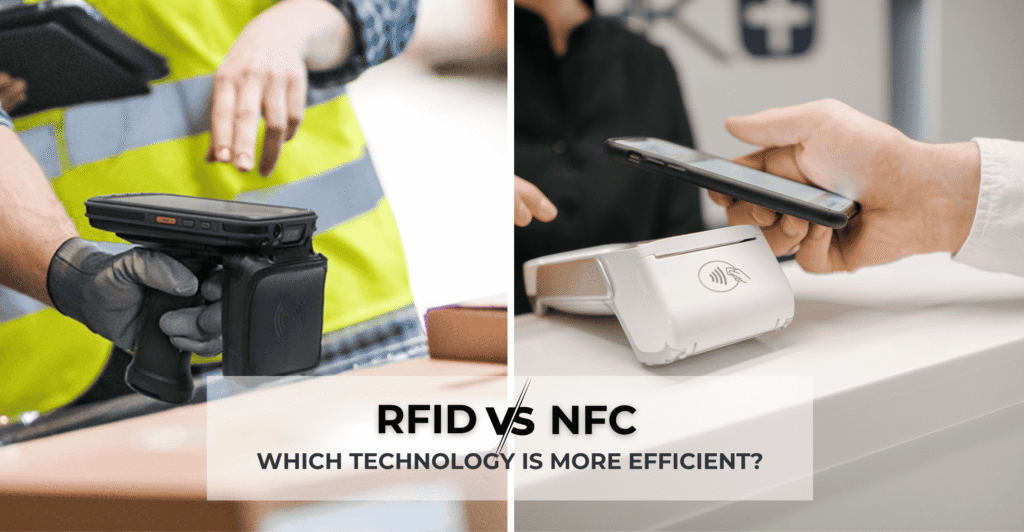
NFC and RFID are two strong technologies that you have probably seen in operation if you have ever tapped your phone to make a payment or seen cartons in a warehouse scanned without any physical touch. Both rely on wireless communication and are changing the way we engage with people, places and things. But they’re not the same and they’re definitely not interchangeable.
We’ve worked on both sides; from helping businesses deploy RFID systems for large-scale inventory to enabling smart card solutions using NFC. So we often get asked: “Which one should I use: RFID or NFC?”
Let’s dive into it.
What is NFC (Near Field Communication)?
Nowadays, NFC is inbuilt in the majority of smartphones and functions over extremely short ranges, usually just over 4-5 cm. NFC is excellent because it doesn’t need a traditional reader device; rather, your smartphone can act as the reader. It’s extensively used for transactions and rapid identity verification due to this. NFC functions at 13.56 MHz, and while its operational frequency resembles that of high-frequency RFID, the two technologies differ as they support distinct standards.
What sets it apart, is its ability to facilitate two-way communication, making it ideal for secure, real-time exchanges such as access control and mobile wallets.
Related product: NFC Cards
Where is NFC used?
- Mobile wallets (Apple Pay, Google Pay)
- Public transport passes and metro cards
- Hotel room key cards
- Tap-based event ticketing
- Smart posters and digital menus
What is RFID (Radio-Frequency Identification)?
RFID, or Radio Frequency Identification, is a system that typically includes a reader, antennas, and tags. It uses radio waves to transmit and receive data. Unlike NFC, RFID doesn’t require close contact — the read range can vary from just a few centimeters to several meters, depending on the type of tag being used.
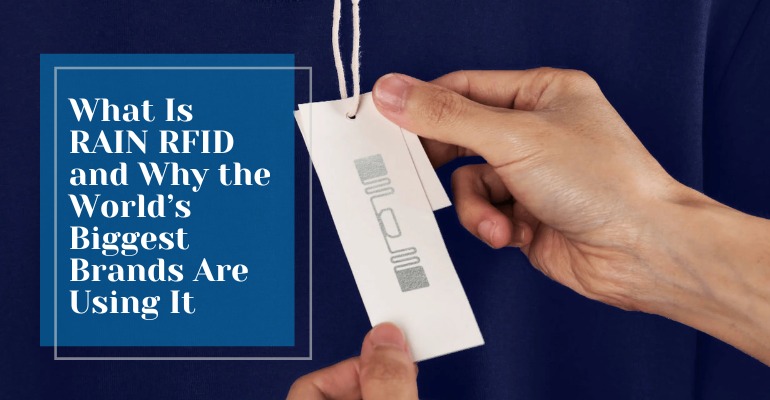
We come across RFID almost every day — from FASTags on vehicles and self-checkout systems in retail stores to faster inventory verification in warehouses.One of the most widely adopted standards for such applications is RAIN RFID, a global wireless technology that enables item-level tracking with high-speed, long-range performance. It’s especially useful in scenarios where scanning each item manually isn’t practical or efficient.
Related product: RFID Tags
Also see: RFID Tag Reader
Where is RFID used?
- Supply chain tracking and inventory automation
- Warehouse and pallet-level identification
- Retail anti-theft systems (EAS + RFID)
- Animal and livestock tracking
- Library management
- Toll collection (e.g., FASTag in India)
When Should You Use What?
- A leading bank needed a way to track over a lakh physical files. We implemented RAIN RFID and reduced manual inventory time from 3 days to under 3 hours.
- An event client wanted a smooth entry experience. We used NFC wristbands that linked to visitor profiles. No lines, no paper.
- A toll plaza project needed high-speed vehicle ID. We deployed RAIN RFID for seamless FASTag processing.
Each of these used the technology best suited to the need. That’s the key. Don’t think of it as “one is better,” think of it as “which is better for my use-case?”
Conclusion: Choose What Fits Best
The decision between RFID and NFC ultimately depends on the situation. RFID excels when you require distance, large-scale scanning, and automation. NFC is unparalleled for secure, contact-based personal engagements.
In numerous instances, both can exist together. Imagine a storage facility where RFID monitors pallets, as employees utilize NFC badges for entry management. It’s not about taking sides; it’s about finding the best solution.
If you’re thinking about creating something intelligent using tags and readers, be it for access, inventory, or payment, our team of experts are here to assist you in selecting the most suitable solution..
Discover our NFC Cards and RFID Readers, or simply contact us if you’d like to discuss the solution.
Frequently Asked Questions:
1. Which technology is better for mobile payments, RFID or NFC?
For mobile payments, NFC (Near Field Communication) is without a doubt the best choice. It is already incorporated into a large number of smartphones, wearables, and point-of-sale devices and was created especially for safe, short-range communication. NFC, rather than RFID, is thus used when you tap your phone or card to finish a payment. It permits contactless, quick, and safe transactions.
2. Is NFC better than RFID?
It depends on the use case. NFC is suited for short-distance, bidirectional communication, such as mobile commerce, access management, and digital authentication. RFID (Radio Frequency Identification) is the preferred technology for logistics, asset tracking, and circumstances requiring the reading of many tags from a distance, such as storage facilities or toll plazas. Neither is essentially superior; they merely serve unique functions.
3. Can a smartphone read RFID tags?
Both yes and no. Most cellphones can read NFC tags, which are classified as HF (13.56 MHz) RFID. However, if you want to scan UHF RFID tags (which are often used in logistics and tolling), your phone won’t cut it. A dedicated UHF RFID reader is required for this purpose.
4. Which is more secure: NFC or RFID?
Higher security is often provided by NFC, particularly when it comes to payment processing and access verification. Through the facilitation of mutual (two-way) authentication and encryption, it reduces the likelihood of data interception. RFID is frequently used in settings with reduced data sensitivity because, particularly in UHF applications, it puts speed and distance above security.
5. What is an RFID tag reader?
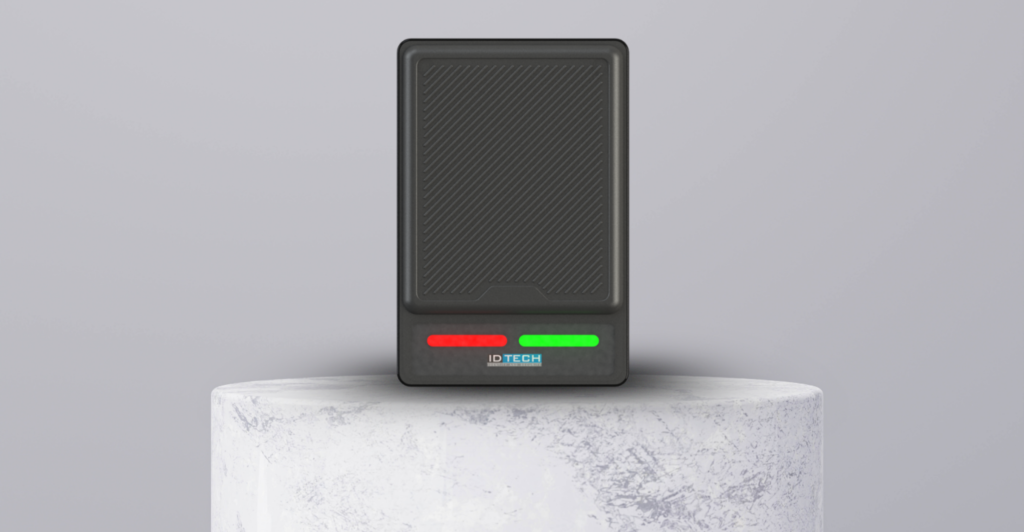
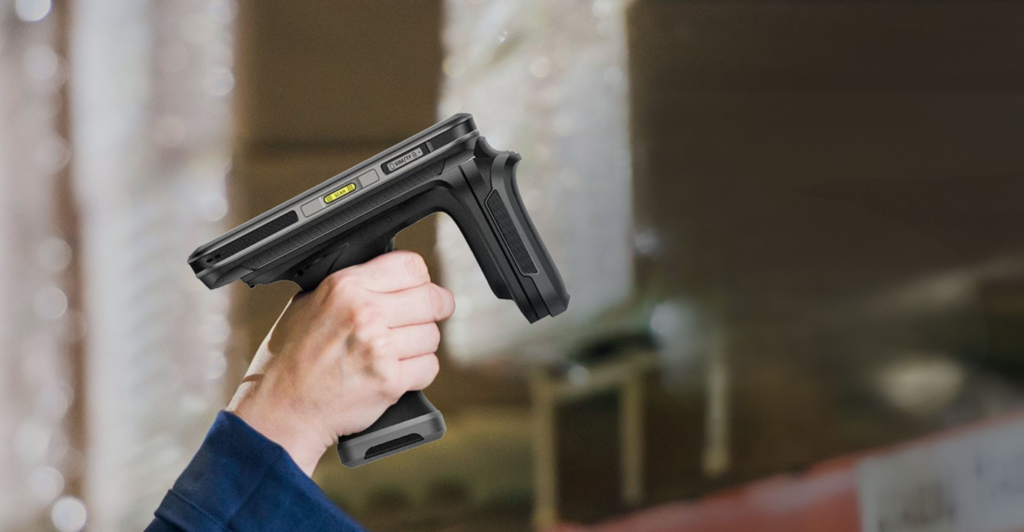
An RFID reader is a gadget that reads and records data from RFID tags using radio waves. These readers may include:
- portable (such as a barcode scanner),
- mounted (in ceilings or gates), or
- integrated into automation systems and kiosks.
The frequency type (LF, HF, or UHF) and the application requirements (such as inventory audits, vehicle identification, or item tracking) are taken into consideration while choosing them.
6. Where is RFID commonly used in real life?
RFID is everywhere; you may simply be unaware of it. RFID streamlines operations by recognizing and monitoring items without needing a direct view, ranging from FASTags on vehicles to stock management in storage facilities. It is used for retail theft prevention gates, library inventory control, medical asset tracking, event ticket handling, and airline luggage management. In conclusion, RFID speeds up the tracking, identification, and management of things.